
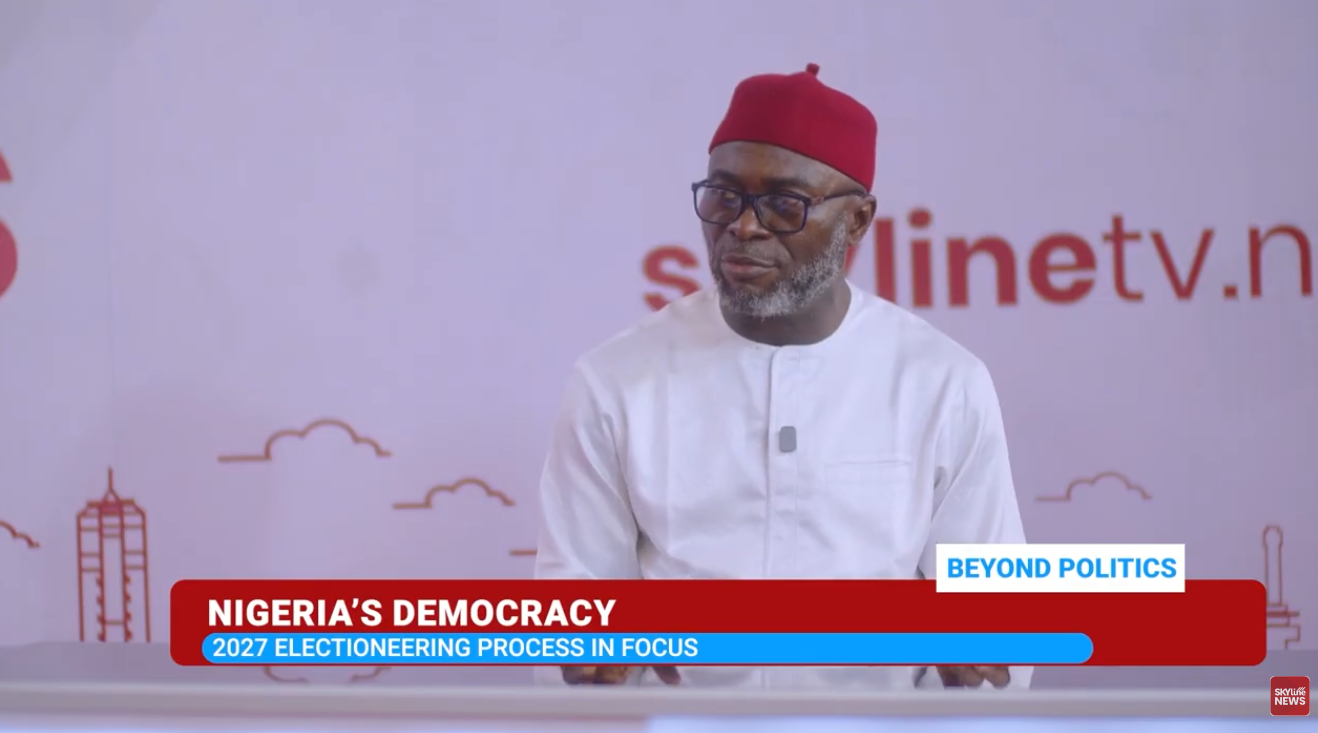
The National Chairman of the National Rescue Movement (NRM) and Director-General of the Inter-Party Advisory Council (IPAC), Prince Dr. Chinedu Obi, has said the 2027 general election will be decided on ideas, policies and the credibility of candidates — not on the boasts of the ruling All Progressives Congress (APC) that there is "no vacancy at Aso Rock."
Speaking on Beyond Politics, a current affairs programme on Skyline News, Obi dismissed the APC's confidence as political theatre, insisting that the Nigerian electorate — not incumbency — would determine the outcome of next year's polls.
"Each time I hear his excellency talk about inheriting a bad economy, the question I always ask is: from who?" Obi said. "If you look at the ballot paper, you don't find the names of any candidate on it. You find political parties. So if his excellency says he inherited a bad economy — which you and I agree is correct because the eight years of Buhari was a mess to Nigeria — he is saying he inherited from his party where the party has kept. He can't run away from the APC."
He added: "If we're talking about a bad economy, they shouldn't run away from it. There's no difference."
"A Different Election"
Obi argued that 2027 will not be business as usual, pointing to the recent national conversation around subsidy removal as evidence that Nigerians are demanding substance from candidates.
"This looks like a different election, because in the last few days we've had discussion around subsidy removal. That's the kind of thing we want to hear in this election — where each of the presidential candidates, each of the political parties, will say what they want to do differently," he said.
"Maybe in past years it was a case of dancing on the stage, all those rhetorics that politicians do. But I think 2027 is becoming issue-based. In the last few years Nigerians have seen the worst of the economy, insecurity and all that. So it shouldn't be business as usual."
He called on the media to hold political parties to account on their value propositions. "We should interrogate these persons individually, vis-à-vis what their political parties say they want to do to Nigerians — not create a narrative of any division. We are not divided."
On the APC's 'Bad Economy' Defence
Obi was unsparing in his critique of the APC's claim that President Bola Tinubu inherited a wrecked economy, noting that Tinubu was a national leader of the APC during the Buhari years.
"If his excellency said he's inherited a bad economy — which you and I agree is correct because the eight years of Buhari was a mess to Nigeria, he killed our economy — he's saying that he inherited from his party where the party has kept," Obi said. "He even said himself that this is a continuation of the Buhari administration, that he takes both the credit and the liabilities himself. So he can't run away from the APC.
"I was a founding member of the APC. I was one of the persons campaigning in 2015 that voted for APC. I ran for the House of Representatives in 2015 under the APC as a founding member. We were the ones who said, let's change things. If the insecurity is still there, it means the APC failed."
He continued: "I should think that when we came, security was at 100 percent — we reduced it. Go to Benue State: you have Nigerians in IDP camps in numbers that will scare you. How many Nigerians travel by road today? How many corps members have been kidnapped going to do national service? These are realities that we see."
Obi invoked the president's own campaign promise on electricity: "The president told us himself during campaign, 'If I don't give you electricity, don't vote for me.' That's on record. Has he given us electricity? I stayed in your studio. I was in your studio for an hour, waiting for light to come back."
"Power Still Belongs to the People"
Turning to the electorate, Obi rejected the narrative that poverty has been weaponised against Nigerian voters to the point where vote-buying has "come to stay."
"I believe very strongly that power belongs to the people. Very strongly. In a democracy, power belongs to the people. If you look at what happened in Osun in the last August 15 election, it is a clear picture that power belongs to the people. Prior to that election, there were attempts by the ruling party to use institutions of government, use executive powers. There were allegations of monies exchanging hands on election day. There were traces of external influence — but the will of the people prevailed."
He urged voters to arm themselves with their Permanent Voter Cards and turn out in force. "First, make sure in this election, if you don't have a voter's card, go and get it. Make sure on election day you come out to vote for a candidate of your choice. If you do that, power still belongs to the people.
"People will say, 'I know they buy votes.' I tell them: if votes don't count, why would a politician spend money buying them? People buy votes because votes count. So electorates should make sure that nobody buys their vote."
He invoked the words of the anti-apartheid struggle: "The greatest weapon of the oppressor is the mind of the oppressed, that tells him he can't do anything. The Nigerian person should know that power belongs to him. If power belongs to you and you're not taking action, someone else will take action."
Rejecting the 'Divided Opposition' Narrative
Obi was emphatic that talk of a fragmented opposition is an orchestrated narrative designed to benefit the ruling party.
"Anybody saying the opposition is divided is trying to create a narrative that will favour him personally. We run a multi-party democracy. Every party is on the ballot because of its own value orientation — what it thinks it's going to sell to the people. I don't expect them to converge. They shouldn't. They're 22 political parties, each should be given a chance to say what it presents to the country.
"I don't agree the opposition is divided. What we should be bothered about is how we interrogate these parties to see their value proposition to the country — not them coming together. They're not the same. If they wanted to be the same, they would have collapsed into one party. This is not a power grab."
He turned the spotlight on the APC itself: "You saw how long it took APC to declare who their candidates were. Does that show a sign of a party that is united? There are persons in APC today that are angry. It took APC more than a month to publish a list of those who participated in their primaries. Some of us are even saying we might go to judicial review to find out whether their candidates' emergence is consistent with the Electoral Act."
On the recently-formed opposition coalition meetings (the "G-100"), Obi was cautious: "It is a shortcut to say let opposition political parties come together and it will be fine. Yes, that will increase the numbers — everybody working together is a shortcut. But it is not the only way to defeat an incumbent. About 18 of the 22 parties have presidential candidates; each one of them working independently can win.
"I don't believe in this kind of conversion where people come with a mindset of 'my candidate should be the one.' What is the guarantee that those supporting Peter Obi would want it to be Peter, or those supporting Atiku would want it to be Atiku? What I think should be our focus is not how many political parties gathered together — not about who is weak and who is strong — it's what is the person presenting to Nigerians. Is he convincing enough to deserve our votes?"
"I Left the APC in Less Than Six Months"
Obi disclosed the personal history behind his current political home, revealing he was a founding member of the APC who left within months of its formation.
"I left APC less than six months of its formation because I expressed interest to run, and the processes I saw then showed me it was not a transparent party. I wrote to everybody. I apologised to Nigerians because I used to have a very long social media followership and people were angry with me that I left to join the APC. When I came back after the experience, I told Nigerians: I'm very sorry about it.
"Senator Dan Sadaal, a two-term senator of the Federal Republic, and a few of us came together to form the National Rescue Movement. The idea is to create a party that would look at how we harness our human and material resources under a regime of rule of law, to create a peaceful society that will be productive, that will give us shared prosperity. That was how my party was founded."
On what distinguishes the NRM from other parties, Obi pointed to organic membership. "NRM is a party owned by members who subscribe to it. It's the only party that sees that you pay a registration fee before you register — not the ones that beg people to come and register and even dash them money. So the membership is organic, of ideologically-minded people — not followers who follow because there's a need for stomach infrastructure."
He added: "The parties you mention — the NDC is less than three or four months old. How do you now talk about it in the league of a party that was registered in 2017 and that was not deregistered in 2020 because we ran elections? NRM has always been in the picture. In the last election in Bauchi, it was a National Rescue Movement governorship candidate that took the matter to the Supreme Court — it took just whiskers, otherwise that was in the bag. The followership of the NRM is real."
On the 2026 Electoral Act: "Retrogressive"
Obi, in his capacity as IPAC Director-General, sharply criticised the 2026 Electoral Act, which he said rolled back the gains of the 2022 Act.
"The entire political parties met and said if nothing was done, we're going to boycott the election. We made two recommendations — one on constitutional review that would impact on electoral reform, and one on the appointment of the INEC chairman, which should be a constitutional matter.
"We talked about the issue of the transmission of results — which was the only problem we found with the last electoral act. In fact, that was the only thing we thought, if we cured it in the 2022 Electoral Act, would be fine, because there was what we called glitches. I've told Nigerians: hate it or like it, the 2023 election is one of the best elections this country has had. The only thing was that because of the glitches that happened, particularly in the presidential election — it didn't happen with the Senate, it didn't happen with the House of Reps — if that had gone right, that election was almost 100 percent.
"So what happened? Instead of curing that little problem, they gave us this headache. Now they've put a proviso that says if you're unable to transmit, you can do it manually. And you know in Nigeria, once you present a proviso, they will dump what is right to do for what is exploitable. When you subject issues to discretion, they can be abused."
The IPAC DG singled out the 10th National Assembly for particular criticism. "I said they would remain in history as the worst National Assembly in this Fourth Republic. We've seen that institution deny the request of the president multiple times in previous assemblies. The 10th is a rubber stamp. Whatever comes to it goes like that. Whereas it was the 9th Assembly that passed the 2022 Electoral Act — which is far better than the 2026 Electoral Act that is taking democracy back like 200 years."
On Insecurity: "Not a Job for Excuses"
Asked about President Tinubu's remark that insecurity is being "strategically weaponised" against his administration, Obi was blunt.
"By who? The primary objective and responsibility of government is the protection of lives and property of Nigerians. Welfare, security, life — that's the primary. So if you're telling me you now have another government that makes it difficult to do it, it's like saying, 'I am incapable of doing my job.'
"His excellency has told us multiple times, 'I prepared for this job. Don't pity me. I know what I'm doing.' So I don't expect it to be a contradiction to tell me this is what you told us you're coming to deal with. Deal with it."
He invoked the Jonathan precedent: "In this same country, former President Goodluck Jonathan told Nigerians that Boko Haram had infiltrated his government — they even had access to his bedroom — and Nigerians for the most part largely sympathised with him. So, President Tinubu presents a similar scenario, and trust me, we take the opposite direction."
On Subsidy: "A Corruption Within a Subsidy"
Obi, who previously supported subsidy removal, said the problem was never the subsidy itself but the corruption that surrounded it.
"If you think it should go altogether — every society must subsidise something. Energy is the driver of every production, everything within the economy. If we need to subsidise it to ensure you create an economy that is robust, so be it. What we had before was not a problem of subsidy. It was corruption within a subsidy.
"I expected what a responsible government in power to do is to deal with that corruption. And even when you're subsidising, you will know the extent to which you're subsidising. And when you do and save some money, we need to see it in the sectors that people can feel — and not tell me you're taking care of me and I'm not seeing myself being taken care of."
He demanded accountability on the savings: "We were buying [fuel] at almost 500 percent of the value when this government came to power. So this savings — and all the revenue generation agencies in Nigeria today say they have overshot their targets. We're doing borrowings: three sources of funds — subsidy savings, overflow of IGR, external borrowing. We don't have light, our roads are bad, our security infrastructure is failing. Where is the money?"
Refusing Foreign Interference
On the recurring speculation about foreign interference in Nigerian elections, Obi was dismissive but firm.
"Those are conspiracy theories — it's neither here nor there. I'm not one of those persons that still believe that yes, the white man may have some plantings. There could have been structures they laid before now that consciously and unconsciously give you an outcome. But I still think the Nigerian people, the political class, must seek to liberate us from any Western mentality.
"Look at what the Chinese people have done. The Chinese would take a model and say, 'We're doing it with Chinese characteristics.' If we know that somebody is going the other way, is anything wrong if we say, 'No, we will not elect anybody'? And somebody will come from anywhere to tell us the person we have elected through a process is not the person they want?
"Today there are divisions, fault lines that have been planted — ethnicity, religion, tribe and all those crazy sentiments. Nigerians must leave these things behind. When we're talking about leadership, we need to look at a leader that has the capacity to deal with our issues. I'm one of the persons who don't care whether we go to Israel, whether we go to America, whether we go to Gabon to take somebody who is competent to deal with making sure Nigeria is fine. Whether you're Yoruba is immaterial to me."
On the Governors' Defection to APC: "A Recipe for Crisis"
Asked about the wave of governors defecting from the PDP and other parties to the APC ahead of 2027, Obi predicted an eventual implosion.
"I predicted many months before now that this rush to collapse everybody [into] the APC would have an implosion. The reason is that the man who is running away wasn't running away because he found the APC more palatable. He thinks it's a survival attempt. He wants to go and reap where he hasn't sown. Now, those who have sown over time, built the structure, and you come in because you think you're coming from another party — you want to take that position. If you do that, that's a recipe for crisis, and it's already there.
"That was why I told you earlier that it took them almost one month-plus to determine who their candidate is. The ideal situation is that you come to a primary, people will be voted for, and the candidate will emerge. It shouldn't take more than a day for us to know who won the primaries conducted by a party — because a primary is an event scheduled for one day."
He added: "If you like, pack every politician into one political party. If Nigerian people say no, the Nigerian people will have their way. These are just psychological machinations of the mind of those who don't understand the process. Even if they have 36 state governors, plus the Minister of the FCT, the 374 local government chairmen with their councillors, all the commissioners all in one party — the Nigerian people can vote them out by 9 a.m. if they want to do so, using a party that probably has not won a councillorship before."
On INEC: "I Don't Envy Them"
Obi offered a nuanced defence of the Independent National Electoral Commission (INEC), even as he criticised the process that produced its leadership.
"The one institution I don't envy is INEC. Just like I told you that the entire political class is less than five percent of our population — the majority are Nigerians — on election day, the number of INEC staff that participate in elections is less than one percent of the people who participate. You have the security angle, the logistics angle, the youth corps, the electoral officers — who majority of the time are recommended by politicians. When these people fail, we blame one institution called INEC. I don't believe that any institution would want to undermine its process for anybody.
"However, we had taught, as an Inter-Party Advisory Council, that it is wrong for a player to recommend his referee — which is what it is in the case of today. The president appoints INEC chairman. No matter how independent an umpire will want to be, if he has his loyalty to his appointer, plus or minus, a natural human being might be influenced.
"We had wanted to remedy it by saying, let's adopt the Uwais report. All the political parties, including APC, were signatories to that recommendation. But the National Assembly didn't think it was necessary."
He proposed an alternative: "Even if you want to think it a bit, we can include civil society as part of the membership. You can even say membership of political parties — because if I'm participating and I'm a member of the committee, I won't sit in that meeting and have somebody who would undermine my party be appointed. But if you now have just one player in the midst of twenty, we're going to have about 18 political parties going for presidency and one of the persons has nominated — it will take God himself to achieve neutrality."
On the NRM's 2027 Prospects
Looking ahead, Obi was buoyant about his party's chances, pointing to its presidential candidate's pledge to deliver 25,000 megawatts of electricity within the first 100 days in office — a figure he said Nigerians were wrong to dismiss.
"Why are Nigerians worried about it and thinking that it's not possible? Because they have a regime over time that cannot boast of 5,000 megawatts. Otherwise, if we deploy multiple sources of energy — which we are lucky to have in many parts of this country — you can use solar, you can use wind, you can use hydro, all sorts of energy generating sources. And the law is now adjusted in such a way that it is not centralised. You can achieve more than 25,000 megawatts within your first 100 days.
"The challenge is that we already have a mindset of failure. So when someone comes with a radical idea, you think it's not possible."
He returned to the central theme of his interview: that 2027 is a referendum on whether Nigeria can be governed differently, and that the power to make that choice rests with the electorate.
"Power belongs to the people. All these narratives are to create a psychological manipulation of the mind. If you have found yourself in this kind of situation and you don't want to make a fault to change it, the situation will remain. In 2027, let all Nigerians take action. Refuse the rhetoric that votes don't count. It's not true. Votes count."
Prince Dr. Chinedu Obi, FCCFI, is the National Chairman of the National Rescue Movement and Director-General of the Inter-Party Advisory Council (IPAC). He spoke on Beyond Politics on Skyline News, Abuja.
This interview has been edited for length and clarity.